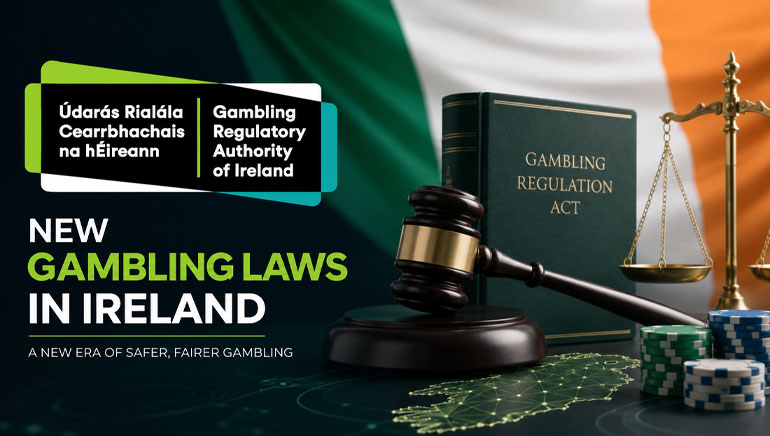
The Gambling Regulatory Authority of Ireland (GRAI) has put together a plan with six strategic focus points to improve the industry, security, and build player trust. The aim is to have noticeable improvement by 2027.
The Gambling Regulatory Authority of Ireland (GRAI) has put plans in place that aim to strengthen the gambling industry by 2027. There are six strategies that they are prioritising, which include licensing, monitoring & compliance, enforcement, consumer protection, governance, and digital innovation.
The main aim is to modernise regulation, create a safer, transparent casino and betting environment, and enhance public trust.
Ireland’s gambling sector has operated under fragmented legislation for quite some time. However, a turning point has been marked by the Gambling Regulation Act 2024 and the establishment of the Gambling Regulatory Authority of Ireland (GRAI).
With their inaugural strategy statement (2025 – 2027), the GRAI has clearly shown how they are planning to build a secure regulatory framework that perfectly balances industry growth and consumer protection.
The licensing objective is to establish a streamlined, transparent regime that will reduce ambiguity and ensure there’s fair competition within the industry. Operators can expect to face clearer requirements.
The idea is to have a fully functioning licensing system by 2027 that will cover all gambling activities, including games of chance (slots, virtual sports, and dice games) and sports betting.
Here, the GRAI aims to develop annual work plans with measurable KPIs using several tools. The latter includes annual reports, financial statements, and compliance reviews submitted to the Minister of Justice.
Focusing on having operators submit to ongoing audits and performance reviews by 2027 to ensure they adhere to regulations.
With this strategic focus, they aim to strengthen enforcement powers to prevent illegal and irresponsible gambling practices. They aim to do this by actively engaging with stakeholders and reporting on any governance requirements.
By 2027, the idea is to have proactive enforcement in place with penalties for non-compliance, along with proper mechanisms to shut down any unlawful operators.
A big focus will be on safeguarding any vulnerable individuals and actively promoting responsible gambling. Measures that will be put in place include public awareness campaigns, enhanced transparency in advertising, and mandatory self-exclusion tools.
The GRAI aims to ensure consumers have the benefit of stronger protections by 2027, including clear dispute resolution channels and proper education on gambling risks.
A top priority is to build on a professional regulatory body with a reputation for accountability. They will recruit several skilled staff, implement proper training and governance reforms.
By 2027, the GRAI will be a recognisable and credible authority with a strong institutional capacity in place.
The idea is to leverage technology to help regulate online gambling more effectively.
Tools that will come into play include digital licensing platforms and real-time monitoring systems. They also plan to use data-driven enforcement so that by 2027, Ireland’s gambling regulation will be fully digitised.
With this, they enable faster response times on any emerging risks within online betting and gaming.
Through this period (2025-2027), the GRAI has various plans in place to measure progress. This includes annual work plans that come with clear timelines and KPIs. They will also provide annual reports to enhance transparency to both the government and the public.
Full stakeholder engagement can be expected to ensure cooperation from operators, consumers, and policymakers. There will also be regular assessments of compliance and organisational effectiveness.
There are a couple of things the GRAI hopes to achieve through these six strategic focuses, including modernising regulation. With their roadmap, they aim to replace any outdated laws through a unified framework that aligns Ireland with the top international practices.
The hope is to not just increase consumer protection but also enhance public trust. With the streamlining of licensing and compliance procedures, they can lower the administrative burden for legal operators.
And with a digital-first approach, Ireland can regulate online gambling properly, even with the quick changes and developments on the cards.
There is some implementation complexity to expect, considering how difficult it is to coordinate across diverse gambling sectors. We can also expect some industry pushback as operators tend to push back against stricter compliance requirements.
Not to mention, there will need to be proper focus on security, as technology is great, but it also comes with the risks of invasion. So, cybersecurity and data privacy need to be safeguarded.
At the end of the day, if successful, the GRAI’s strategic plan will have completely reshaped the Irish gambling industry by 2027. Creating a modern, transparent, player-focused sector that benefits from a digital-first approach and transparency.
The admin and work at present will be a lot, but if the focus and plans remain steady, then success might just be on the table. Which ultimately will benefit players, operators and government alike.


 Blackjack
 Slots
Slots Roulette
 Video Poker
 Baccarat
 Craps
Craps